|
|
.gif)
|


 |
 |
 |
|||||
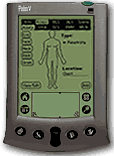
Point-and-click software developed at Penn State U for use with handheld computers is enhancing patient care by helping ambulance personnel collect data more efficiently and provide more information to hospital emergency departments. Janet Jonson, associate research engineer at Penn State's Applied Research Laboratory (ARL) leads the project team. She says the new Penn State software is unique in providing ambulance personnel with a point-and-click method for recording information.
The information entered via point and click can then be transferred to the Emergency Department right from the scene via wireless-cellular modem. Or, the information can be transferred by "beaming" it from the Palm to a printer at the hospital that supports infrared technology. In addition, the new software enables the information collected during an ambulance run to be uploaded quickly to a desktop PC to complete the administrative record and report information for the statewide, pre-hospital trip report required by Pennsylvania law. "Field trials are showing that the new software enhances record accuracy. It also can help ambulance personnel provide a higher level of patient information and save significant amounts of time when they complete the pre-hospital trip report," Jonson notes. Currently, the new application is being used in field trials by Danville Ambulance in Danville, Pa., and by Alpha Community Ambulance Services, Inc. in State College, Pa. The Life Flight helicopter crews at Geisinger Health Systems in Danville will soon join the field trials. Dr. Douglas Kupas, Emergency Department physician at Geisinger, is serving as medical adviser to the application development team. "We recognized early on that ambulance personnel needed a better, quicker, way to communicate patient information to receiving hospitals, particularly, for trauma patients in rural areas. Delayed reports about what happened at the scene of an accident can delay treatment," says Kupas. "Although we started this project with the idea of helping trauma patients, it quickly became evident that all patients served by ambulance personnel could benefit from the improved communication and record keeping," he adds. Roger Bressler, Alpha paramedic, has participated in the software field trials from the start. Alpha staff currently share 10 Palm III handheld computers equipped with infrared ports. Three of the company's five ambulances also have Palms with keyboards aboard. Bressler estimates that Alpha personnel make 10 to 12 runs in a 12-hour period and that three or four could require an hour or two of overtime to prepare trip sheets. Using the new software and hand held computers, the same record keeping task can take only 15 minutes. "If you are familiar with the technology, it saves time and improves accuracy," says Bressler. "You can write narratives while you are looking at the patient." Scott Danowsky, EMS Coordinator for the Emergency Department at Geisinger, has also participated in the pilot project from the start. He says that between 12 and 15 Danville ambulance crewmembers are currently using the new software and handheld computers. Five Life Flight helicopter crewmembers are being trained in the new application. Eddie Crow, ARL associate research engineer and project team manager, says "The overall emergency services response to a vehicle crash and accident victim is improved with the use of this new technology through accurate and complete health status information sent to the emergency department physician." The Geisinger Health System and Penn State's Applied Research Laboratory are the principal parties in the pilot program. The Pennsylvania Department of Health, Bureau of Emergency Services is providing support for the field trials. Med-Media, Inc., a platform and architecture solutions development company based in Harrisburg, Pa., currently has a license to develop and market the software under the brand name R-EMstat.
|
|||||||
 |
 |
 |
|||||