|
|
.gif)
|


 |
 |
 |
||||||
Title Electronic Prescribing: Criteria for Evaluating Handheld Prescribing Systems and an Evaluation of a New, Handheld, Wireless Wide Area Network (WWAN) Prescribing System Participants Orin M. Goldblum, MD University of Pittsburgh Medical Center University of Pittsburgh Medical Center
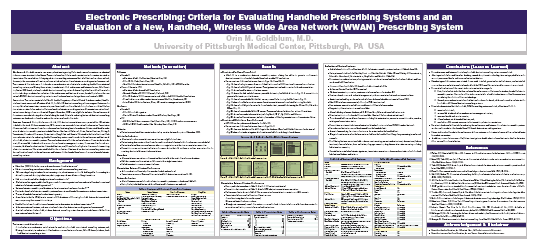
(Click on the image to open the PDF presentation) Abstract Electronic Prescribing: Criteria for Evaluating Handheld Prescribing Systems and an Evaluation of a New, Handheld, Wireless Wide Area Network (WWAN) Prescribing System Orin M. Goldblum, M.D. Clinical Assistant Professor of Dermatology, Department of Dermatology, University of Pittsburgh Medical Center, Pittsburgh, PA BACKGROUND Handheld computer use among physicians is growing. Palm-sized personal computers are expected to become more important in healthcare.(1) These units have the ability to send prescriptions to pharmacies via wireless transmission.(2) The complexities of designing electronic prescribing systems and their ideal features have been outlined,(3) however, in the peer-reviewed literature, only one critical evaluation of an electronic prescribing system has appeared.(4) The purposes of this study were: 1) to develop a comprehensive set of criteria for evaluating handheld computerized prescribing systems; and 2) using these criteria, to evaluate out-of-box performance and features of a new, Palm Operating System (OS)-based, wireless, handheld electronic prescribing system. A dermatologist familiar with healthcare information technology conducted an evaluation of the performance and features of a new, handheld, WWAN electronic prescribing system in an office-based practice during a three-month period in 2000. INNOVATION The system consisted of a Palm Vx handheld organizer, a Novatel Minstrel V wireless modem, OmniSky wireless internet access and ePhysician ePad 1.1, the Palm OS electronic prescribing software program. System performance, defined as transmission success rate, was determined from data collected during the three-month trial. Evaluation criteria consisted of an analysis of features found in electronic prescribing systems. All prescriptions written for all patients seen during a three-month period (August – November, 2000) were eligible for inclusion. The performance of the system was evaluated using data collected during the study. Criteria for evaluating features of electronic prescribing systems were developed and used to analyze the system employed in this study. LESSONS LEARNED During this three-month trial, 200 electronic prescriptions were generated for 132 patients included in the study. Of these prescriptions, 92.5 percent were successfully transmitted to pharmacies. Transmission failures resulted from incorrect facsimile numbers and non-functioning facsimile machines. Criteria established for evaluation of electronic prescribing systems included System (Hardware & Software), Costs, System Features, Printing & Transmission, Formulary & Insurance, Customization, Drug Safety and Security. This study is the first effort to establish comprehensive criteria for evaluating handheld prescribing systems and to evaluate the performance and features of a handheld, electronic prescribing system. The results demonstrated that the evaluated system: 1) was simple to implement; 2) successfully interfaced with a commonly-used practice management system; 3) was user-friendly and easy to operate; 4) offered a robust variety of standard features; and, 5) resulted in a high rate of success for transmitting electronic prescriptions. The criteria established for the evaluation of features of an electronic prescribing system can be used to critically evaluate the performance and features of other handheld and personal computer-based electronic prescribing systems. REFERENCES 1. Noffsinger R, Chin SJ. Improving the delivery of care and reducing healthcare costs with the digitization of information. J Healthc Inf Manag 2000;14:23-30. 2. Strongin RJ. Physician connectivity: electronic prescribing. Issue Brief Natl Health Policy Forum 2000;752:1-6. 3. Keet R. Essential characteristics of an electronic prescription writer. J Healthc Inf Manag 1999;13:53-61. 4. Rivkin S. Opportunities and challenges of electronic physician prescribing technology. Med Interface 1997;10:77-83. ACKNOWLEDGEMENT The author thanks ePhysician, Inc. (Mountain View, CA) for their support of this project. Keywords A 1 - Communication B10 - Primary care providers C 1 - Ambulatory practice D 9 - Technical feasibility Dr. Orin Goldblum can be reached via email
|
||||||||
 |
 |
 |
||||||